
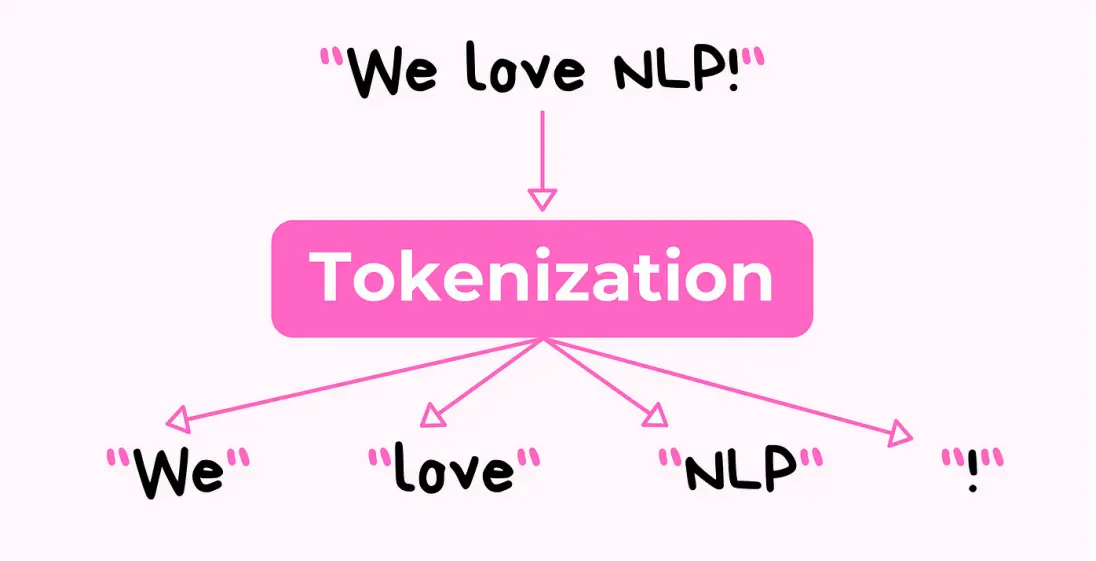
Word Level Tokenzation
Splitting text into individual words “the quick brown fox” -> [“the”,”quick”,”brown”,”fox”]
- Straight-forward and simple.
- Flexible for furthur processing ; part-of-speech tagging,NER,syntactic parsing
- Adapts to multiple languages
- Allows model to focus on relationships between words
BUT
- Ignores multi-words, punctuations within words..etc
- Large Vocabulary size (English has 180k active words) leading to higher computational demand
- Dependency on the context to tokenize
Character Level Tokenization
Splitting text into individual characters “the quick brown fox” -> [“t”,”h”,”e”,” “,”q”,”u”,”i”,”c”,”k”, …]
- Simple and Efficient. English has only 26 characters
- No out-of-vocabulary issues. Train and test vocabulary
are mostly the same. - Adapts to any language
- Robust to spelling errors
But
- Increases model complexity
- Loss of high-level info like morphology, syntax, semantic relationships, sentiment etc
- Doesn’t capture long-range dependencies
- Requires more training data than other tokenizations
N-GRAM MODELS
Splitting text into groups of consecutive words. N is the no. of words in a token. For a trigram model, “the quick brown fox jumps” -> [“the quick brown”,”quick brown fox”,”brown fox jumps”]
- Captures the context in the sentence
- The choice of N allows for flexibility
- Foundation to many probabilistic language models
- Still used in text-completion for gmail, google search, plagarism detection.
But
- Smaller “n” values don’t capture relationships well.
- Larger “n” lead to sparsity and high dimensionality
- As “n” increases, parameters increase exponentially
- Don’t capture long-range dependencies
Long-range dependency
Here’s why long range dependency is crucial yet difficult
Syntactic dependencies
- “The man next to the large oak tree near the grocery
store on the corner is tall.” - “The men next to the large oak tree near the grocery
store on the corner are tall.”
The verb here depends on the noun which is 12 n-grams away. It is hard to capture this relationship with a n-gram model.
Byte Pair Tokenization (BPT)
It iteratively merges the most frequent adjacent pairs of chars(bytes) and forms new tokens. For simplicity, Let’s say we have a small train dataset: “aaabbbbccda”
- Start with char level tokens: [‘a’,’b’,’c’,’d’]
- Find the most frequent pair of adjacent tokens: ‘bb’
- Create a new token by merging the pair in step 2 , New tokens : [‘a’,’b’,’c’,’d’,’bb’]
- Repeat until a stopping criterion is met
GPT, BERT,RoBERTa are some of the popular models using BPT. It is currently the most popular tokenization for LLMS.
- BPE is efficient in handling rare words as it breaks them down to sub words.
- Doesn’t require large vocabulary
- Adaptable to many languages and domains
- Capture long-term dependencies
But
- Characters are merged purely on frequency leading tocontext insensitivity
- When a new token shows up; the tokenizer needs to be re-trained to incorporate it
- BPT in itself is a model,i.e., it is trained seperately with it’s own dataset, algorithms and hyper-parameters.
A few more SoTA tokenizers
- SentencePiece (LLAMA)
- WordPiece (DistilBERT, Electra)
- Domain-specific : Biomedical, code tokenizers
- YouTokenToMe (NVIDIA NeMo)
Model Capacity
Model width and depth combinedly indicate the capacity of model to fit a dataset.
- If model capacity is too much for the problemcomplexity, overfitting happens
- if model capacity is not enough for the problem capacity, underfitting happens
- The parameters and computational cost increases as model capacity increases
Find a sweet balance between
- Underfitting
- Overfitting
- Computation cost
Learning Rate
The size of optimization step taken to minimize loss function
Common starting point : 0.01 or 0.001
LOSS CURVE ANALYSIS
- If the loss decreases slowly, increase the learning rate
- if the loss drops and then become stagnant, decrease the learning rate
- if the loss drops and then starts increasing, decrease your learning rate.
AUTOMATED APPROACHES
- Learning Rate Schedules
- The Learning Rate Range Test
- Cyclical Learning Rates
- Bayesian optimization
Learning Rate vs Objective function

Batch Size
The no of inputs that are passed to the model before updating it’s weights
- HARDWARE : Large batch sizes need more memory
- As the batch size increases, the convergence speed increases
- Find a good balance between training speed and convergence quality
- Higher learning rate works well with larger batch size
THUMB RULES
- Start with largest batch size your memory can handle
- if overfitting, reduce batch size
Activation Functions
Made a seperate post on this. link in comments.
Thumb Rules
- Start with ReLU for hidden layers, then GeLU and Tanh
- If binary classification use Sigmoid for output
- If multi-class, use Softmax for output
- For transformer-based models, start with GeLU
- If you observe “dying relu problem”, try Leaky ReLU
Regularization Techniques
Add a penalty or include randomness in training to reduce overfitting.
Dropout: Easiest form of regularization. dropout rate is typically between 0.2-0.5
L2 Regularization (Ridge): If dropout doesn’t work, try this
L1 Regularization (Lasso) : Useful if your data is sparse.
Data Augmentation: More data can act as a regularization
Ensembling: Increases generalization hence, reduces overfitting. Last option.
Optimizers
Optimizer decides the way you update your weights based on your loss.
SGD: Simplest optimizer. Slow but reliable. A good beginner option.
SGD with momentum: time consuming but a great learning experience.
ADAM: Most popular choice for the current models. Fast and complex.
RMSprop: Works well with RNNs.
Train and Error (not a typo!)
The guidelines and thumb rules are a great way to start but at the end it’s all empirical. In most cases, you will start with a pre-trained model. Start with the default hyper-parameters and then change based on model performance. You can control the speed and complexity but you can’t control the performance of your model. Sometimes, You just need to try all feasable options and find out the best combo.
CREDITS FOR FIGURES
https://deepai.org/machine-learning-glossary-and-terms/hyperparameter
https://www.jeremyjordan.me/nn-learning-rate/