5 AI Engineer Interview Concepts You Must Know in 2026

Forget memorizing another list of LangChain APIs. If you understand these five concepts deeply, you can handle the questions that separate AI application builders from AI engineers. Introduction I’ve noticed a pattern in AI Engineer interviews. The candidate’s resume looks impressive: Then the interviewer asks: “Why does your RAG system still hallucinate even though retrieval … Read more

What Is Retrieval-Augmented Generation (RAG)? A Practical Guide with Python Examples

RAG

Learn how RAG works, why LLMs hallucinate, and build your first Retrieval-Augmented Generation pipeline in Python. Find all tutorials here Introduction Large Language Models (LLMs) have transformed how we build AI applications. Today, we can ask models to: Tools like ChatGPT, Claude, Gemini, and Llama make these tasks feel almost magical. But there’s one major … Read more

How to Fix LangChain OutputParserException in Production LLM Pipelines

When your LLM returns malformed JSON, the problem isn’t always the model. Here’s how to build structured, validated, and production-ready outputs with Pydantic and Instructor. Your LLM application works perfectly in development. You deploy it. A few hours later, production logs start filling up with errors: Or perhaps: The frustrating part? The model’s answer looks … Read more

Why RAG Chatbots Struggle in Production

“Our RAG chatbot worked perfectly in the POC.But once we scaled to 50,000 documents… accuracy dropped to 60%.” If you’ve worked with enterprise RAG systems, you’ve probably heard this story. And if you ask most engineers what went wrong, you’ll hear answers like: ❌ These sound smart❌ They sometimes help❌ But they miss the real … Read more

What is Stacking of Models in Machine Learning?

The last Ensemble method we will discuss in this series is called stacking (short for stacked generalization). It is based on a simple idea: instead of using trivial functions (such as hard voting) to aggregate the predictions of all predictors in an ensemble, why don’t we train a model to perform this aggregation? Figure below … Read more

Ensemble Learning: A Comprehensive Guide to AdaBoost and Gradient Boosting

Introduction: In the realm of machine learning, ensemble learning techniques such as AdaBoost and Gradient Boosting have revolutionized the way we approach classification and regression tasks. These powerful algorithms harness the collective intelligence of multiple weak learners to create a robust and accurate predictive model. In this tutorial, we’ll embark on a journey to explore … Read more

Introduction to Dimensionality Reduction

The text discusses the curse of dimensionality in machine learning, highlighting challenges in high-dimensional spaces. It suggests reducing features to improve training efficiency and visualization, while addressing potential information loss and risks of overfitting with increased dimensions. Dimensionality reduction techniques will be explored further.

Sending Data in Unstructured File Form

Unstructured data files consist of a series of bits. The file doesn’t separate the bits from each other in any way. You can’t simply look into the file and see any structure because there isn’t any to see. Unstructured file formats rely on the file user to know how to interpret the data. For example, … Read more

Random Forests | Machine Learning from Scratch

As we have discussed, a Random Forest is an ensemble of Decision Trees, generally trained via the bagging method (or sometimes pasting), typically with max_samples set to the size of the training set. Instead of building a BaggingClassifier and passing it a DecisionTreeClassifier, you can instead use the RandomForestClassifier class, which is more convenient and … Read more

Accessing Data in Structured Flat-File Form

In many cases, the data you need to work with won’t appear within a library, such as the toy datasets in the Scikit-learn library. Real-world data usually appears in a file of some type, and a flat file presents the easiest kind of file to work with. In a flat file, the data appears as … Read more

Gini Impurity or Entropy? How to decide the root node in decision tree?

By default, the Gini impurity measure is used, but you can select the entropy impurity measure instead by setting the criterion hyperparameter to “entropy”. The concept of entropy originated in thermodynamics as a measure of molecular disorder: entropy approaches zero when molecules are still and well ordered. It later spread to a wide variety of … Read more

Decision Trees | Machine Learning from Scratch

Like SVMs, Decision Trees are versatile Machine Learning algorithms that can perform both classification and regression tasks, and even multioutput tasks. They are very powerful algorithms, capable of fitting complex datasets. For example, you trained a DecisionTreeRegressor model on the California housing dataset, fitting it perfectly (actually overfitting it).Decision Trees are also the fundamental components … Read more

How can A linear model learn non-linear/discrete patterns?

Introduction During model development, one of the techniques that many don’t experiment with is feature discretization. The core idea is to transform a continuous feature into discrete features, mostly one-hot encoded. 𝐖𝐡𝐲 𝐰𝐨𝐮𝐥𝐝 𝐰𝐞 𝐝𝐨 𝐭𝐡𝐚𝐭? My rationale for using feature discretization has almost always been simple: “It just makes sense to discretize a feature.” … Read more

Support Vector Machines (SVM) Algorithms

A Support Vector Machine (SVM) is a very powerful and versatile Machine Learning model, capable of performing linear or nonlinear classification, regression, and even outlier detection. It is one of the most popular models in Machine Learning, and anyone interested in Machine Learning should have it in their toolbox. SVMs are particularly well suited for … Read more

What is early stopping? | Machine Learning from Scratch

Machine learning models, particularly those trained iteratively using algorithms like Gradient Descent, face the risk of overfitting the training data. One powerful and elegant solution to this challenge is known as “Early Stopping.” In this blog post, we’ll delve into the concept of Early Stopping, explore its effectiveness, and showcase a practical implementation using a … Read more

Information Gain in Machine Learning

Information Gain

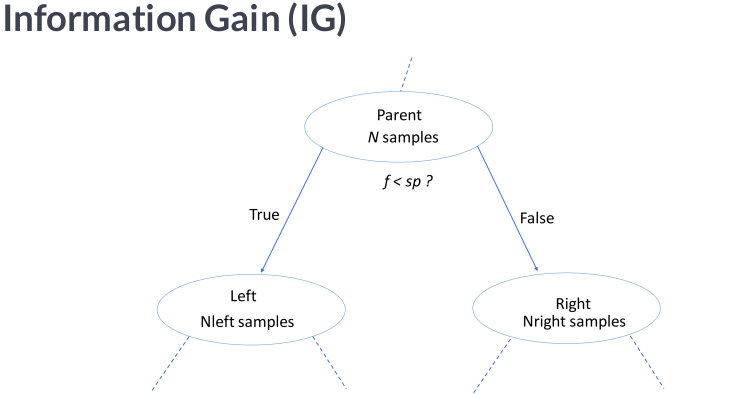
Information Gain (IG) is critical in machine learning and decision tree algorithms, particularly in data classification and 𝐟𝐞𝐚𝐭𝐮𝐫𝐞 𝐬𝐞𝐥𝐞𝐜𝐭𝐢𝐨𝐧. Information Gain Information Gain is a concept used in the field of machine learning and decision trees to measure the effectiveness of an attribute in classifying a dataset. It is commonly employed in the construction of … Read more

What is Lasso Regression? | Machine Learning from Scratch

Least Absolute Shrinkage and Selection Operator Regression (simply called Lasso Regression) is another regularized version of Linear Regression: just like Ridge Regression, it adds a regularization term to the cost function, but it uses the ℓ1 norm of the weight vector instead of half the square of the ℓ2 norm. Figure below shows the same … Read more

Regularized Linear Models(Ridge Regression) | Machine Learning from Scratch

As we saw in previous posts, a good way to reduce overfitting is to regularize the model (i.e., to constrain it): the fewer degrees of freedom it has, the harder it will be for it to overfit the data. For example, a simple way to regularize a polynomial model is to reduce the number of … Read more

Learning Curves | Machine Learning from Scratch

bias-and-variance.

Till now, We have read about Gradient Descent,Min-Batch Gradient Descent,Stochastic Gradient Descent and other type of Gradient Descents and Polynomial Regression. In this post we will learn about Learning Curves in Machine Learning . Introduction Learning curves are graphical representations of how a model’s performance changes over time as it learns from training data. These … Read more